Boom Lift Operator Training
Boom lift training for articulating and telescopic booms: OSHA 1926.453, harness and lanyard use, stability and a hands-on evaluation on your lifts.
What to Expect
Articulating and telescopic boom lifts reach higher and farther than any other MEWP, and that reach is what makes them dangerous: operators can be thrown from the basket, the machine can tip on soft ground or a slope, and the platform can be driven into overhead lines or steel. Our course covers the boom lift rules in 29 CFR 1926.453 and the ANSI A92 practices, then evaluates each operator on your machine.
- Standards
- 29 CFR 1926.453 (aerial lifts); ANSI/SAIA A92.22 and A92.24 (MEWP Group B)
- Who needs it
- Operators of articulating and telescopic boom lifts, occupants who ride the platform, and supervisors who direct the work
- Fall protection
- Full-body harness with a lanyard attached to the boom or basket, never to an adjacent structure
- Format
- Onsite at your job site, yard or facility, on your own equipment: classroom instruction, hands-on practice and an evaluation on the machine.
What OSHA's aerial lift rule requires
Under 29 CFR 1926.453(b)(2), lift controls must be tested each day before use, only authorized persons may operate the lift, and workers must stand firmly on the basket floor, never on the rails or on planks or ladders. A lanyard must be attached to the boom or basket, and belting off to an adjacent pole, structure or equipment is not permitted. Manufacturer load limits can't be exceeded, brakes must be set and outriggers placed on pads or a solid surface, and an aerial lift truck can't be moved with the boom elevated and workers in the basket.
Harnesses, not body belts
The aerial lift standard still says "body belt." Since January 1, 1998, body belts have not been acceptable as part of a personal fall arrest system (1926.502(d)), so boom lift occupants use a full-body harness and a lanyard sized for the platform. The course covers inspecting the harness, where to anchor in the basket, and why tying off to a nearby beam turns a stable lift into a hazard if it moves.
What the course covers
- Daily test of platform and ground controls before use
- Full-body harness and lanyard: inspection and anchoring in the basket
- Stability: ground conditions, slopes, outriggers, wind and platform load
- Travel with the boom stowed or as the manufacturer allows
- Overhead power lines, structures and crushing hazards at the platform
- Using ground controls to bring down an operator in an emergency
- Safe use plan, site risk assessment and rescue planning
- Familiarization on your articulating and telescopic models
- Covers OSHA 1926.453
- Built on ANSI A92
- Harness & Lanyard Training
- Emergency Lowering Practice
- Hands-On Evaluation
- Proof of Training Records
Trusted Since 2014
Disabled Veteran-Owned Small Business — serving clients nationwide.
Request a Free Consultation
Fill out the form below and we'll be in touch within one business day.
Other courses we deliver
- Aerial Lift TrainingMEWP operator training for scissor lifts and boom lifts, built on ANSI A92.22 and A92.24 and the OSHA rules, with hands-on evaluation on your lifts.
- Scissor Lift TrainingScissor lift training built on OSHA's scaffold rules and ANSI A92: guardrails, tip-over and collapse hazards, and a hands-on evaluation on your lifts.
- Telehandler TrainingTelehandler training built on OSHA's forklift rule, 1910.178(l): load charts, boom stability, rough terrain and a practical evaluation on your machine.
What Our Clients Said
- Expert Safety Training
- Customized Safety Programs
- OSHA Compliance Support
- Industrial Hygiene Surveys
- Onsite Safety Inspections
- Written Safety Program Development
“Brad and his team are very helpful and knowledgeable. They came to our job site and conducted safety training that was not only thorough and compliant, but genuinely engaging for our crew. I highly recommend BHG Heavy Equipment to any company that takes workplace safety seriously.”
Boom Lift Training Questions
We get a lot of the same great questions from new clients. Here are the answers to the ones we hear most often — if yours isn't listed, don't hesitate to reach out directly.
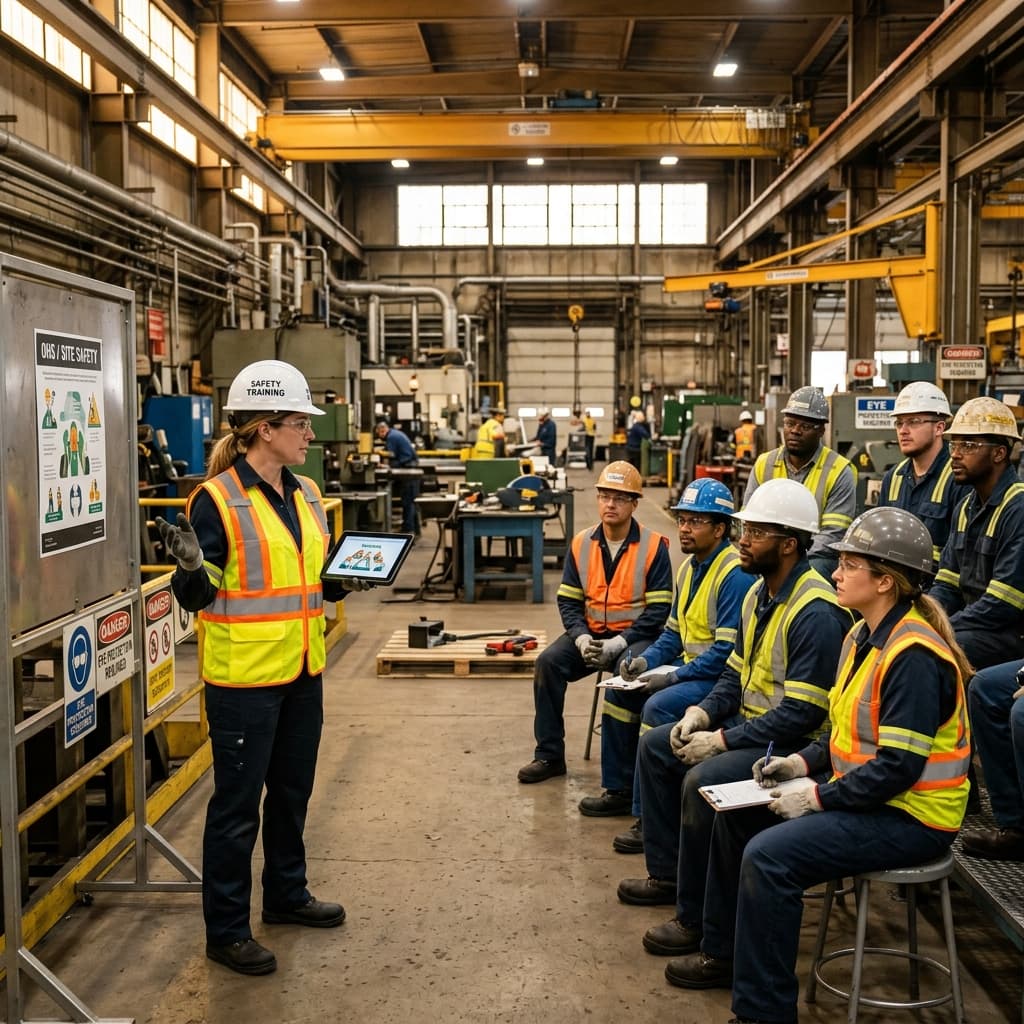
Onsite Safety Training Session